
A Quick Historical Insight
The term dyscalculia was first introduced in the 1940s and later defined in detail by researcher Ladislav Košč in 1974.
Before that, children struggling with maths were often misunderstood or labeled as careless or lazy. Today, neuroscience confirms that dyscalculia is linked to how the brain processes numbers—especially areas like the intraparietal sulcus, which controls numerical understanding.
Is Dyscalculia Considered a Learning Disability?
Yes—dyscalculia is officially recognized as a learning disability.
In clinical terms, it falls under: “Specific Learning Disorder with impairment in mathematics.”
This means:
- The child has normal intelligence
- But struggles significantly with maths compared to peers
- And it affects academic performance or daily life
Organizations like the American Psychiatric Association define it as a mathematical disability that interferes with everyday functioning.
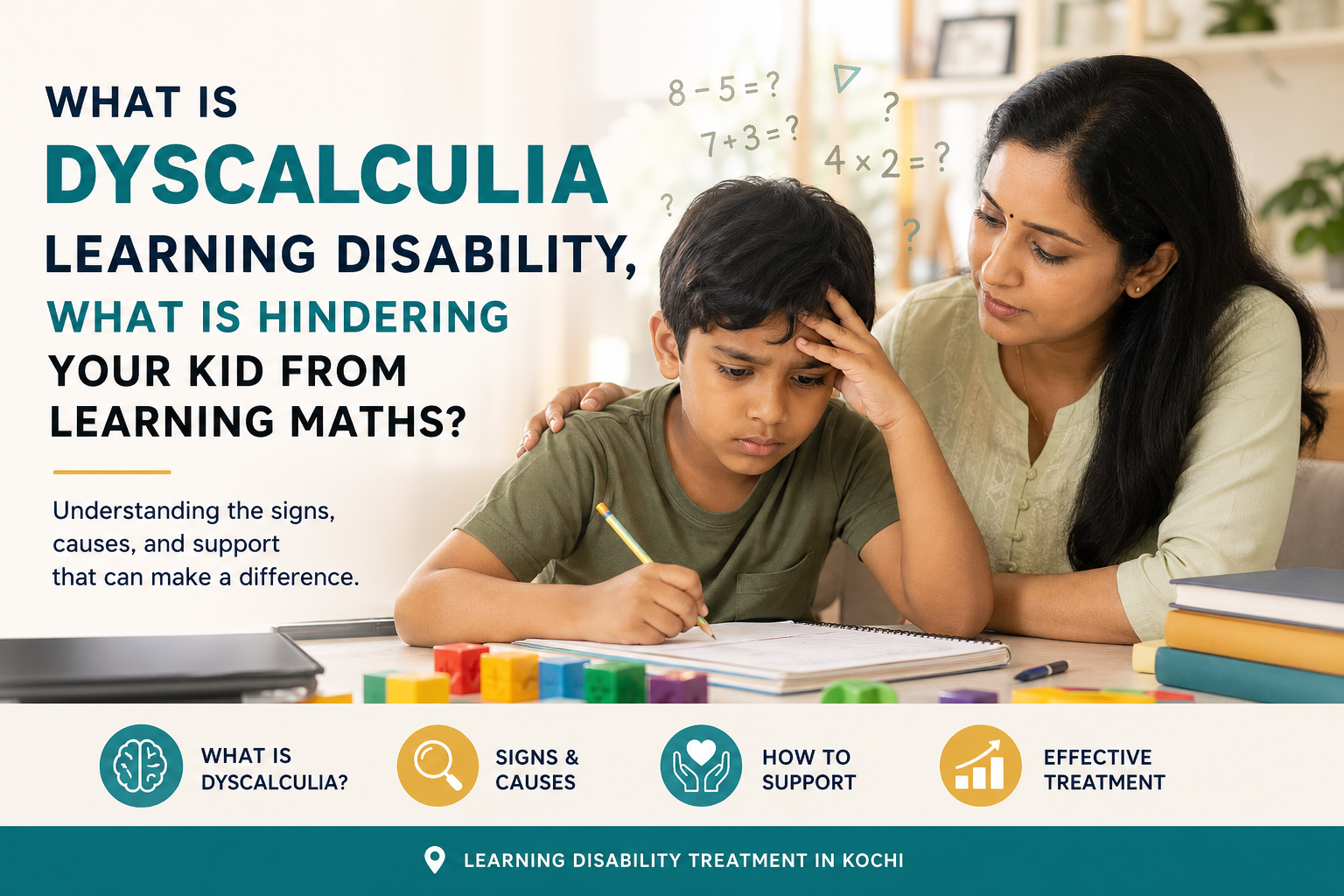
What is Hindering Your Child from Learning Maths?
If your child has dyscalculia, the problem is not effort—it’s how the brain processes numbers.
Key blocks include:
1. Weak Number Sense
Children struggle to understand quantities (e.g., which is bigger: 8 or 5).
2. Memory Issues
They may forget basic facts like:
- 2 + 3
- Multiplication tables
3. Difficulty in Patterns & Logic
Math isn’t just numbers—it’s patterns. Dyscalculia disrupts that understanding.
4. Visual-Spatial Confusion
Numbers may appear jumbled or hard to align properly.
5. Slow Processing Speed
Even simple calculations take longer, leading to frustration.
Symptoms of Dyscalculia in Children
Watch for these early signs:
- Difficulty counting or recognizing numbers
- Trouble telling time or understanding money
- Struggling with basic operations (add, subtract)
- Avoiding maths-related tasks
- Using fingers for simple calculations beyond expected age
- Anxiety or stress during maths activities
These signs often appear in early childhood and persist if not supported.
What Causes Dyscalculia?
There isn’t a single cause—but research points to:
 Genetic Factors
It often runs in families.
Brain Development Differences
Certain brain regions process numbers differently.
Environmental Factors
Limited exposure or poor teaching methods can worsen symptoms.
Associated Conditions
Sometimes linked with:
- ADHD
- Dyslexia
- Premature birth or developmental delays
How Dyscalculia Blocks Maths Learning
Think of maths like a building:
- Numbers = foundation
- Operations = walls
- Problem-solving = roof
In dyscalculia, the foundation itself is unstable.
So even if a child tries to memorize:
- They don’t truly understand
- Concepts don’t connect
- Learning becomes mechanical, not meaningful
This is why repeated practice alone doesn’t work.
Is There a Treatment for Dyscalculia?
Here’s the truth: There is no “quick cure”, but there is effective support.
Treatment focuses on:
- Improving number sense
- Using alternative learning strategies
- Building confidence
Early intervention makes a huge difference.
How to Treat Dyscalculia (Practically)
1. Individualized Learning Plans
Every child learns differently—custom strategies matter.
2. Multisensory Teaching
Use:
- Visual aids
- Physical objects
- Games
3. Step-by-Step Concept Building
Don’t rush into complex maths.
4. Consistent Reinforcement
Small, repeated learning builds long-term understanding.
5. Emotional Support
Math anxiety is real—confidence is key.
In cities like Kochi, many parents now actively seek learning disability treatment in kochi, combining therapy, special education, and structured intervention programs for better outcomes.
How to Teach a Child with Dyscalculia Maths
Here’s what actually works:
- Use real-life examples (money, shopping, time)
- Break problems into smaller steps
- Encourage visual learning (charts, diagrams)
- Use apps and interactive tools
- Avoid pressure—focus on progress, not perfection
Most importantly: patience beats pressure.
Final Thoughts
If your child struggles with maths, don’t jump to conclusions like “not interested” or “not smart.”
Sometimes, it’s simply the brain working differently.
Dyscalculia is real, common, and manageable—affecting up to 1 in 15 children globally.
With the right awareness, early support, and structured learning approach, your child can succeed—not just in maths, but in life.